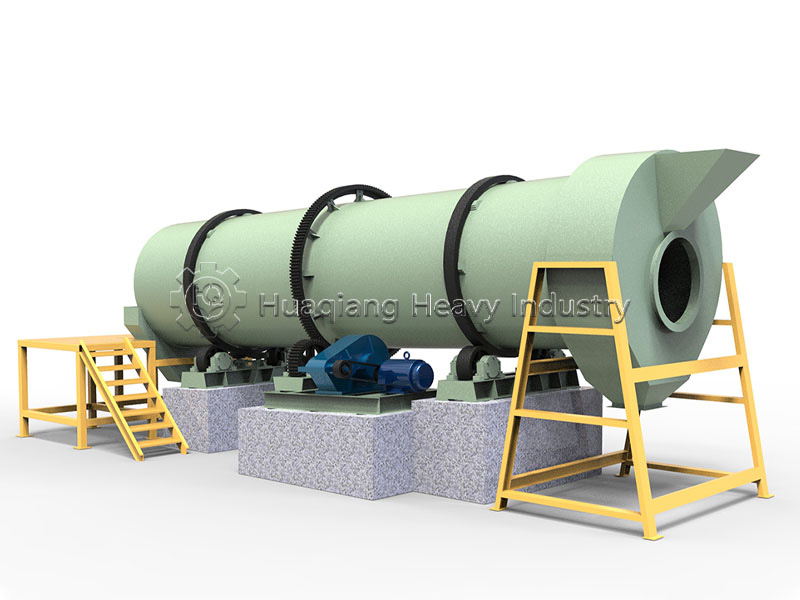
In modern fertilizer production and agricultural planting, fertilizer granulators are indispensable core equipment. They primarily process powdered, loose organic fertilizers and compound fertilizers into uniformly sized, compact granules, completely solving many drawbacks of traditional powder fertilizers. This provides crucial support for improving fertilizer quality and efficiency, large-scale production, and scientific fertilization, serving as a vital link between fertilizer processing and high-efficiency agriculture.
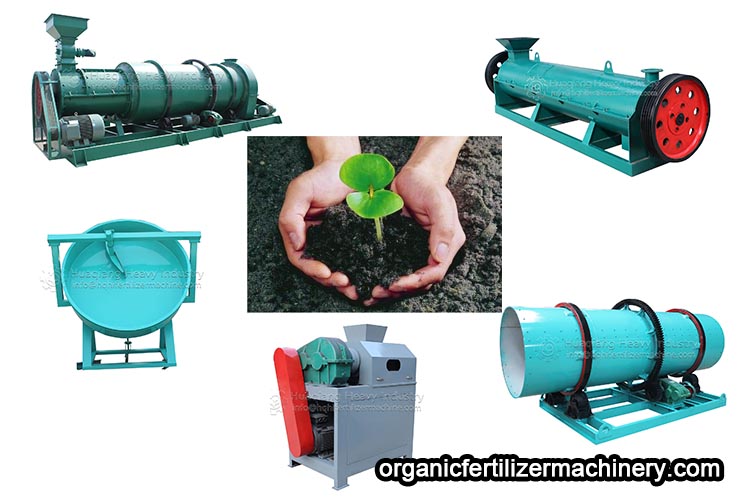
Optimizing the physical properties of fertilizers is the most fundamental function of a granulator. Traditional powder fertilizers are loose in texture, easily absorb moisture and clump, and are prone to scattering and loss during transportation and storage, wasting raw materials and polluting the environment. Granulated fertilizers processed by a granulator have a compact structure, uniform particle size, and strong stability, making them less susceptible to moisture absorption, clumping, and dust loss. This significantly reduces losses during fertilizer transportation, storage, and application, effectively saving production costs. Simultaneously, the uniform granule shape is compatible with various mechanized fertilization equipment, making spreading, drip irrigation, and hole application more convenient, thus facilitating large-scale, mechanized agricultural operations.
Improving fertilizer utilization and application efficiency is the core value of fertilizer granulators. During the granulation process, the equipment mechanically mixes and extrudes the fertilizer, ensuring uniform mixing of nutrients such as nitrogen, phosphorus, potassium, and organic matter. This avoids the problems of uneven nutrient distribution and localized enrichment found in powdered fertilizers. Once in the soil, the granulated fertilizer does not dissolve and run off quickly, allowing for slow nutrient release, extending the fertilizer's effectiveness period, and continuously supplying nutrients to crops. This avoids fertilizer waste and seedling burn, while also improving crop absorption efficiency, contributing to increased crop yield and quality.
Furthermore, granulators play a vital role in environmental protection, revenue generation, and resource regeneration. They can process agricultural waste such as livestock manure, straw residue, and mushroom residue into high-quality granular organic fertilizer through fermentation, achieving the recycling of agricultural waste and reducing environmental pollution caused by livestock and planting waste. Simultaneously, scattered waste materials are transformed into standardized commercial fertilizers, increasing fertilizer added value and helping farmers and fertilizer companies increase their income.
In conclusion, fertilizer granulators balance production efficiency, fertilization effect, and ecological benefits. They are key equipment for the green and standardized development of modern agriculture, laying a solid foundation for high-quality and efficient agricultural development.



.jpg)