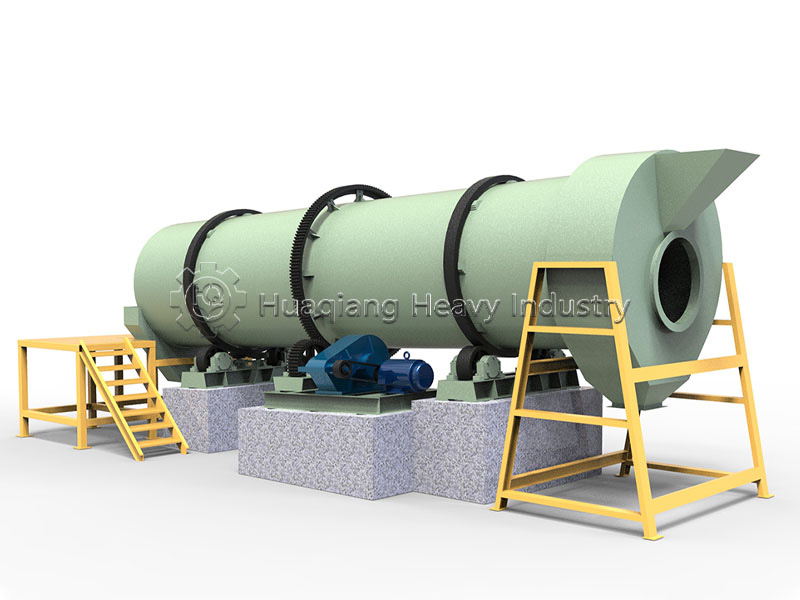
In the production process of granular organic fertilizer, the granulator is the core piece of equipment that determines the quality, output, and appearance of the final product. Many newcomers to the industry are unfamiliar with the various types of organic fertilizer granulators; however, the mainstream equipment currently on the market falls into three categories: stirring-tooth granulators, disc granulators, and flat-die pellet machines. These three models operate on different principles and vary significantly in terms of suitable raw materials and production capacity, making them suitable for organic fertilizer processing plants of various sizes—large, medium, and small.
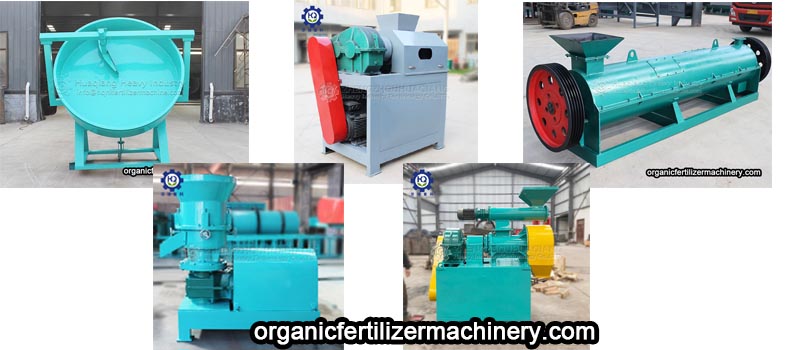
The stirring-tooth granulator—also known as a wet-process granulator—is currently the most widely used and versatile granulation equipment. It relies on high-speed rotating teeth to strike and compress materials, causing powdered organic fertilizer to agglomerate into spherical granules. Its greatest advantage is its ability to handle high-moisture materials without requiring strict pre-drying; fermented livestock manure and straw powder can be granulated directly, effectively reducing production costs. It offers rapid granulation, stable output, and produces round, uniform granules. It is suitable for medium-to-large organic fertilizer production lines and is the preferred choice for the resource utilization of livestock manure at farms.
The disc granulator is a traditional wet-process granulator that operates by rolling and agglomerating materials within an inclined rotating disc. Its standout feature is the excellent quality and high sphericity of the granules, resulting in a premium-grade product suitable for high-end commercial organic fertilizers. The equipment is easy to operate and runs stably, allowing for real-time monitoring of the granulation process and convenient parameter adjustment. However, it has distinct drawbacks: it imposes strict requirements on material moisture content and particle fineness, and offers relatively low output, making it better suited for precision, small-batch production scenarios.
The flat-die pellet machine is a dry-process extrusion granulator that forms granules by pressing material through a die, requiring no added water or moisture. The resulting granules are hard, durable, and resistant to breakage during storage, with minimal dust generation and low product loss. This equipment is suitable for dry powdered raw materials, straw powder, and spent mushroom substrate; it produces highly compact granules, making it ideal for customers who require high fertilizer stability. Its disadvantages include significant equipment wear and tear and a requirement for consistent moisture levels in the raw materials.
In summary, each of the three types of granulators has its own advantages and disadvantages. For new plant setups, a stirring-tooth granulator is a cost-effective choice suitable for processing wet materials; a disc granulator is ideal for producing high-end finished products; and a flat-die pellet machine is the best option when prioritizing granule hardness and storage stability. Selecting the right equipment based on specific needs ensures the efficient and stable operation of the production line.



.jpg)