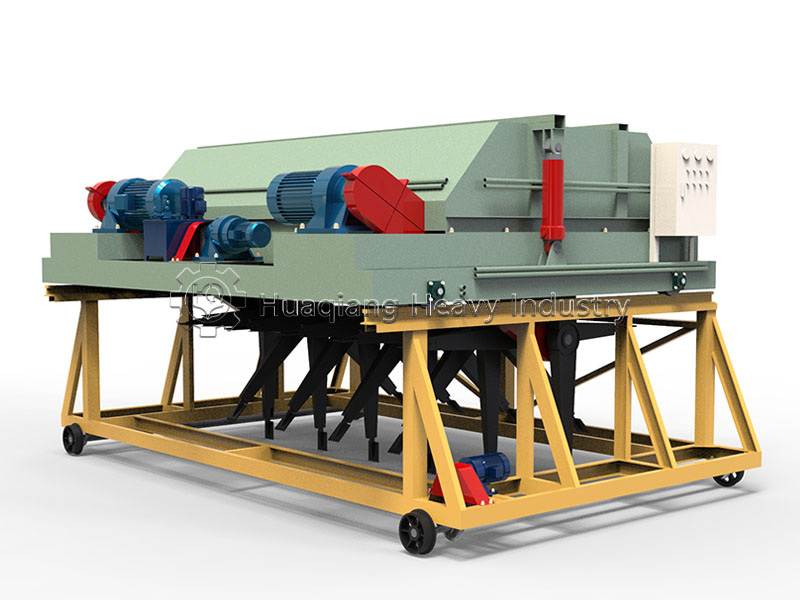
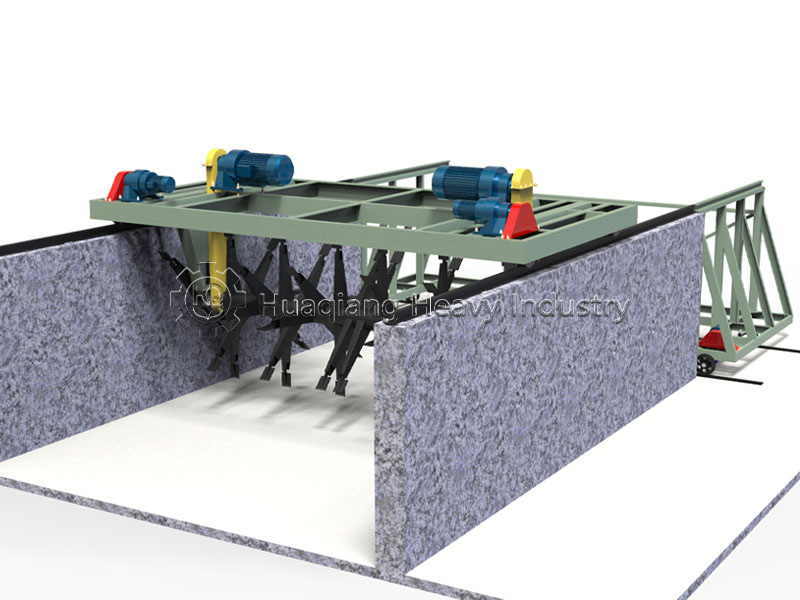
The double screws compost turner is the core piece of equipment for aerobic fermentation in-trough systems. It is widely used for the decomposition of organic waste, such as livestock and poultry manure, crop straw, and sludge. Developed by Huaqiang Heavy Industry, this machine utilizes a dual-shaft, counter-rotating auger structure to turn, aerate, pulverize, and displace materials. It ensures a stable and efficient fermentation process for organic fertilizer and serves as a critical component within an entire organic fertilizer production line. The machine consists of a rail-mounted travel mechanism, two symmetrical auger shafts, a hydraulic lifting system, a power transmission unit, and an electrical control system; it operates by straddling the fermentation trough, moving along rails installed on either side.

Its core operating principle involves two parallel auger shafts rotating synchronously in opposite directions, equipped with wear-resistant, staggered helical blades. As the machine moves forward along the fermentation trough, the helical blades reach into the bottom of the material pile, lifting the material upward through the thrust generated by the augers. Because the two augers rotate in opposite directions, the material is subjected to bidirectional shearing forces during the lift—breaking up clumps while simultaneously tossing and mixing the material. Oxygen-depleted material from the bottom is brought to the surface, while oxygen-rich material from the surface is moved deeper into the pile. This vertical exchange ensures a continuous oxygen supply for the fermentation microorganisms, preventing the development of anaerobic conditions, foul odors, and uneven decomposition.
A hydraulic system allows for the adjustment of the auger shafts' height, accommodating varying pile depths and the specific requirements of different fermentation stages. During the turning process, the material is not only flipped vertically but also shifted laterally, being gradually and systematically pushed toward the discharge end of the fermentation trough. This integrates the turning and displacement processes, reducing the need for manual intervention and facilitating continuous production. Compared to single-auger turners, the dual-auger design offers greater turning depth, a wider coverage area, fewer "dead zones" within the trough, and superior pulverization capabilities—effectively breaking down large chunks and significantly improving overall aeration.
From the perspective of fermentation technology, the fundamental purpose of turning is to regulate and maintain an optimal aerobic environment. The decomposition of organic materials relies on aerobic microorganisms. Under oxygen-deficient conditions, the fermentation process stalls, leading to the production of foul-smelling gases such as hydrogen sulfide. A double screws compost turner periodically turns the material, continuously replenishing oxygen while dissipating carbon dioxide and water vapor generated during fermentation. Simultaneously, it balances the temperature throughout the pile, preventing localized overheating that could kill the microbial cultures; this ensures uniform decomposition across the entire fermentation trench and shortens the overall fermentation cycle.
Designed for large-scale, trench-based fermentation in organic fertilizer plants, this equipment offers stable operation and moderate energy consumption, making it a mainstream solution for the resource utilization of organic waste. A thorough understanding of its operating principles enables operators to effectively manage turning frequency, travel speed, and auger depth—thereby maximizing equipment performance and ensuring the consistent production of high-quality, well-decomposed organic fertilizer.