Leveraging the superior mobility of its crawler undercarriage, a crawler-type compost turner eliminates the need for permanent fermentation bays. It enables aerobic windrow composting directly on open ground, integrating the functions of turning, crushing, aeration, and mixing. Thanks to its agility and adaptability to complex terrain, it is widely used in sectors such as integrated crop-livestock farming, organic fertilizer production, and environmental solid waste treatment. It stands as one of the core fermentation pieces of equipment promoted by Huaqiang Heavy Industry.
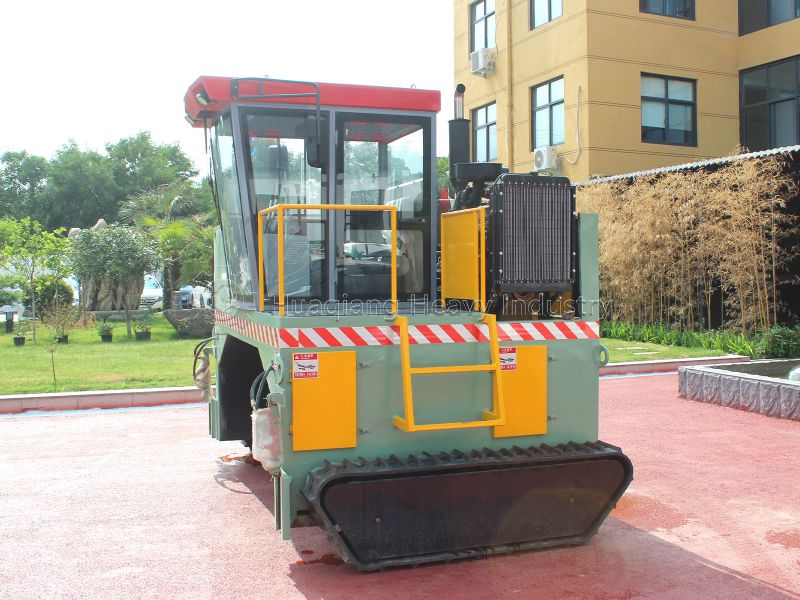
Large-scale livestock and poultry farms represent its primary application scenario. The manure and waste generated by pigs, cattle, chickens, and sheep can easily produce foul odors and contaminate soil and water if left in simple, unmanaged piles. A crawler-type compost turner allows for on-site processing: manure is mixed with bulking agents—such as straw or mushroom substrate—and turned to increase oxygen levels. This promotes high-temperature decomposition, eliminates pathogens and insect eggs, and ensures the harmless treatment of waste, meeting environmental compliance standards. The resulting compost can then be returned to the land, fostering an integrated crop-livestock circular system—an ideal solution for small-to-medium-sized farms and family-run agricultural operations.
Organic fertilizer plants and agricultural production bases also rely heavily on this equipment. Small-to-medium-sized organic fertilizer facilities often require flexible site layouts and frequent adjustments to windrow positioning; the crawler-type compost turner’s ability to move freely and execute zero-radius turns makes it perfectly suited for managing multiple batches of raw materials. Orchards, vegetable farms, and agricultural cooperatives can establish simple, on-site composting areas to process straw, fruit and vegetable scraps, and mushroom substrate. This allows them to produce their own organic fertilizer, reducing the costs of purchasing external fertilizers while improving compacted soil—aligning perfectly with the requirements of ecological farming.
Furthermore, this equipment plays a vital role in the treatment of municipal and industrial organic solid waste. It is highly effective for the stabilization of various organic waste streams—including dewatered sludge from wastewater treatment plants, garden waste (such as branches and leaves), distillers' grains, filter cake from sugar refineries, and by-products from soy-product processing—through the windrow composting method. Crawler-mounted chassis are well-suited for muddy or soft terrain, as they are resistant to slipping or sinking. This makes them highly applicable for solid waste disposal sites in rural towns and for projects supporting "zero-waste city" initiatives.
Furthermore, this equipment can be utilized in substrate production and soil remediation projects. Crawler-type compost turners are effective for mixing and aerating materials—whether for the fermentation and maturation of seedling substrates and horticultural potting soils, or for the preparation of organic fertilizers used to improve saline-alkali or degraded soils. Compared to stationary, trough-style composting systems, these units require less investment in civil infrastructure, allow for faster deployment, and are less constrained by site conditions.
In summary, crawler-type compost turners offer both cost-effectiveness and versatility. By facilitating the critical process of transforming organic waste into fertilizer, they serve as an efficient, low-cost solution for composting and fermentation within the contexts of rural environmental protection and the development of green agriculture.