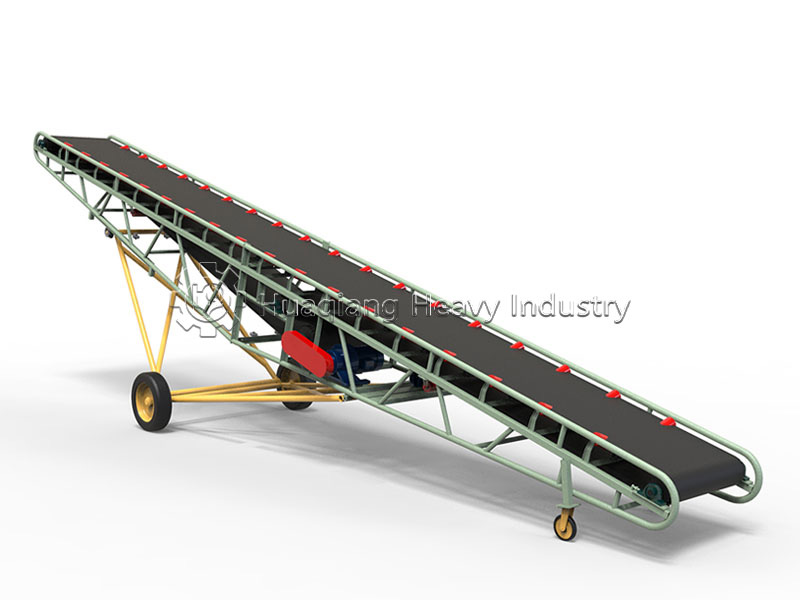


Mobile belt conveyor is a flexible material handling equipment, mainly used for short distance transportation of bulk materials or finished items, especially suitable for occasions that require frequent changes in work positions. This type of conveyor is widely used in construction sites, port loading and unloading, mining, logistics centers and other fields, which can significantly improve the flexibility and efficiency of material handling.
The main structure and components of a mobile belt conveyor include:
Conveyor belt: made of materials such as rubber, canvas, or plastic, forming a circular belt for carrying materials.
Drive device: including motor, reducer, and drive drum, providing power for the conveyor belt.
Reversing drum: used to change the direction of the conveyor belt, usually located at the end of the conveyor.
Support frame and idler: The support frame is used to support the entire conveyor structure, while the idler supports the conveyor belt to reduce running resistance.
Walking mechanism: including wheels, tracks or tracks, etc., to enable the conveyor to move.
Control system: used to control the start, stop, walking direction, and speed of the conveyor.
Safety devices: such as emergency stop switches, anti deviation devices, etc., to ensure the safety of operators and equipment.
The working principle of a mobile belt conveyor is similar to that of a fixed belt conveyor, with the main difference being its increased mobility:
Material conveying: Materials are placed on a conveyor belt and transported to the designated location as the belt continues to run.
Mobile: By operating the walking mechanism, the conveyor can be moved to different positions at the work site to adapt to different operational needs.
High flexibility: able to quickly move to different positions according to homework needs, improving work efficiency.
Strong adaptability: Suitable for various work environments and material types, including bulk materials and packaged items.
Compact structure: usually designed as lightweight, easy to move and operate.
Easy to operate: Equipped with a control system, operators can easily control the start, stop, and movement of the conveyor.
Cost saving: Reduced the infrastructure investment required for fixed conveyors and lowered the overall cost of material handling.
Safety: Multiple safety devices are installed to ensure the safety of operators and equipment.| Length | -6(-10)M | -6(-10)M | -6(-10)M | -10(11-)M | -10(11-)M | -10(11-)M |
| Width | 500 | 650 | 800 | 500 | 650 | 800 |
| Height | 80 | 80 | 100 | 0 | 0 | 0 |
| Power | 2.2(3) | 3(4) | 5.5(7.5) | 3(4) | 3(4) | 5.5(7.5) |
| Rotation Speed | 72 | 72 | 55 | 55 | 55 | 55 |
| Transport volume | 7-10 | 10-18 | 15-20 | 10-19 | 13-25 | 20-45 |
| Angle | 20-60 | 20-60 | 20-60 | 0-23 | 0-23 | 0-23 |
| Transmission mode | Direct connection of reducer | Direct connection of reducer | Direct connection of reducer | Trigonometric belt | Reducer chain | Reducer chain |
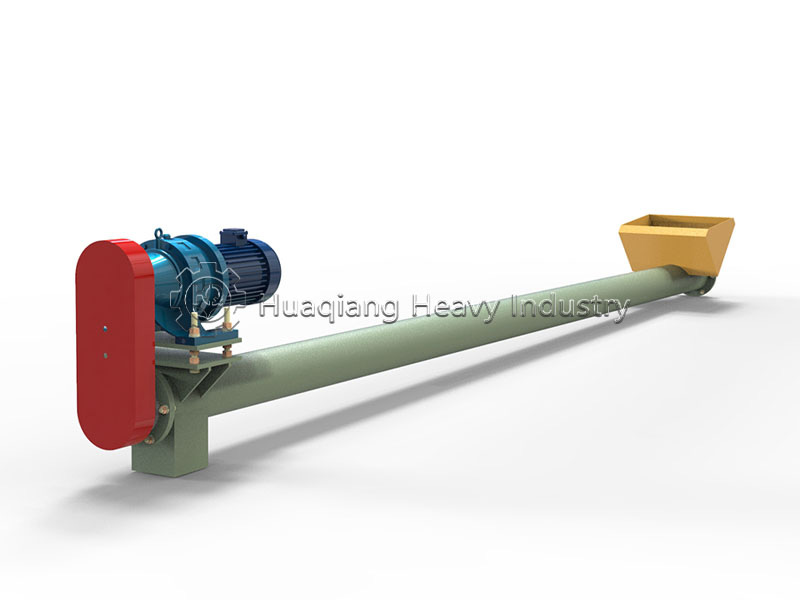
The screw conveyor is a product designed by our company, which combines the experience of all kinds of screw conveyor at home and abroad. The product can meet the transportation of various materials and be matched with all kinds of mixing machines.
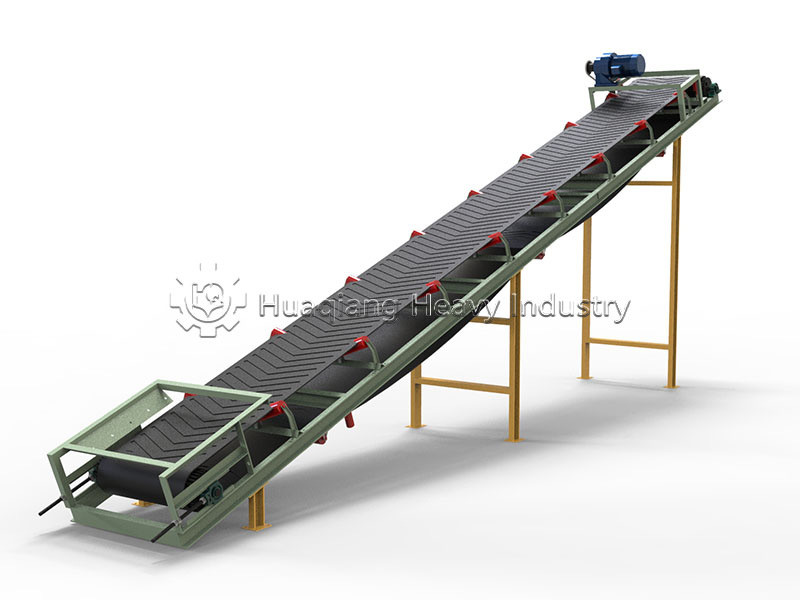
Belt conveyor is widely used in metallurgy, mine, coal, port, transportation, water and electricity, chemical and other departments to carry on, loading, reloading or accumulating all kinds of normal temperature, loose density of various kinds of bulk, du
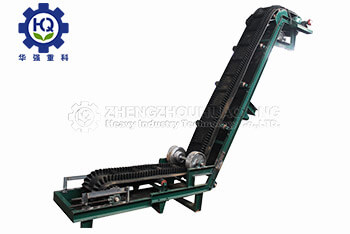
This series of products is mainly suitable for high inclined continuous conveying of bulk materials. With the conveyor belt with corrugated side plate and diaphragm plate, the transmission angle is 0 ~ 90°.