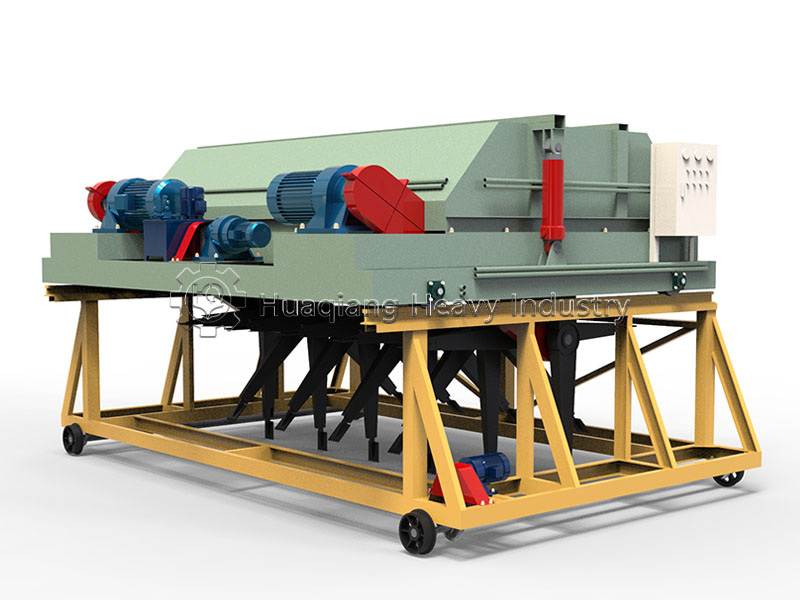
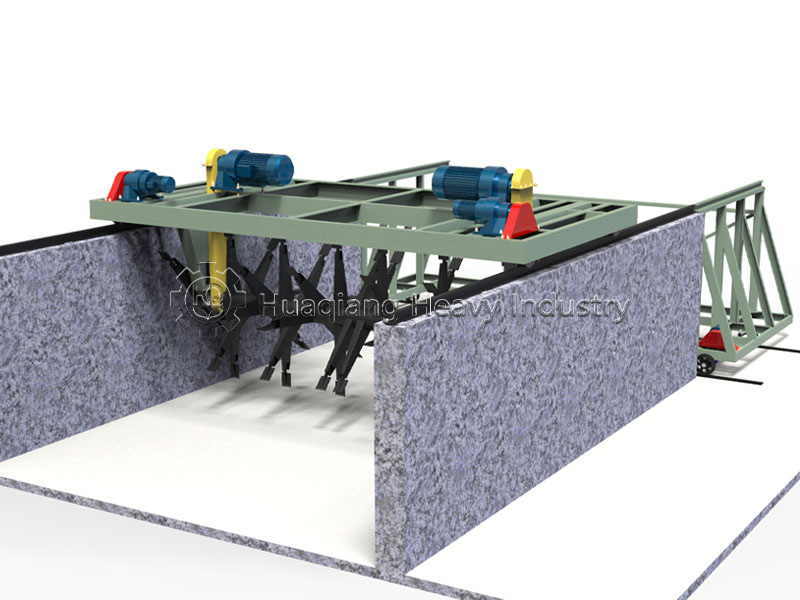
The core of aerobic fermentation for organic fertilizer lies in turning the material to supply oxygen. While there are many types of compost turners on the market—such as crawler-type, disc-type, and drum-type models—the double screws compost turner from Huaqiang Heavy Industry stands out. Its unique design, featuring two counter-rotating helical shafts, sets it apart from traditional models in terms of turning logic, fermentation efficiency, energy consumption, and material adaptability. It is a highly specialized piece of equipment designed specifically for trough-based fermentation processes.

First, the turning mechanism differs. Crawler-type compost turners use a travel mechanism to drive a turning roller that stirs the material; while highly mobile and well-suited for open-air windrows, they have limited turning depth, often leaving anaerobic zones at the bottom of the pile. Disc-type and standard drum-type turners primarily break up and shift material laterally, which often fails to ensure sufficient vertical mixing between the upper and lower layers. In contrast, the dual-helix turner utilizes two counter-rotating helical shafts that simultaneously break up clumps and forcibly lift oxygen-deprived material from the bottom to the surface, while pushing surface material downward. This creates a continuous vertical circulation, fundamentally resolving the issue of uneven fermentation across different layers and ensuring a higher degree of uniformity.
Second, there is a difference in material adaptability. Large wheel compost turners are well-suited for loose raw materials with moderate moisture content, such as manure; however, they are prone to material buildup and clogging when handling highly viscous sludge, filter cake, or sticky biogas residue. Crawler-type machines, meanwhile, have limited capacity for breaking down large, hard clumps. The double screws compost turner, with its blades that continuously cut and stir, offers superior crushing capabilities. It excels with challenging-to-ferment materials—such as high-moisture, viscous substances, sludge, and sugar mill filter cake—preventing the material from compacting or becoming "stifled" (anaerobic). This leads to better odor control and a more consistent fermentation cycle.
There are also differences regarding energy consumption and site utilization. Crawler-type compost turners do not require the construction of fermentation troughs, offering greater site flexibility, though their energy consumption per unit of material is relatively high. Large wheel compost turners, while capable of handling high volumes, involve greater machine weight and higher power consumption. Huaqiang Heavy Industry’s double screws compost turner is designed for use with standardized fermentation bays. It offers a turning depth of up to 1.7 meters, with customizable bay widths, ensuring high land-use efficiency and lower energy consumption for a given processing capacity—making it an ideal choice for integrated, continuous production lines. The machine travels along a fixed rail at a constant speed and supports both automated and remote-controlled operation; a single operator can manage the turning process for an entire fermentation bay, significantly reducing labor costs.
Naturally, there are limitations to its application. As a specialized machine for bay-style composting, the double screws compost turner requires dedicated fermentation bays and rails, making it unsuitable for sites with scattered layouts or open-air composting. In contrast, crawler-type (tracked) compost turners offer greater mobility, making them the preferred choice for smaller-scale operations or dispersed composting sites. For projects requiring exceptionally high capacity, large wheel compost turners are a more appropriate solution.
In short, there is no single "best" compost turner; the right choice depends on your specific needs. If your raw materials are highly viscous, require a high degree of fermentation uniformity, and you are planning a fixed, bay-based organic fertilizer production line, the double screws compost turner is the superior option. For open-air composting or sites with variable layouts, a crawler-type compost turner is more suitable. Selecting the right equipment based on raw material characteristics, facility layout, and production capacity targets is essential for ensuring a stable and efficient fermentation process.