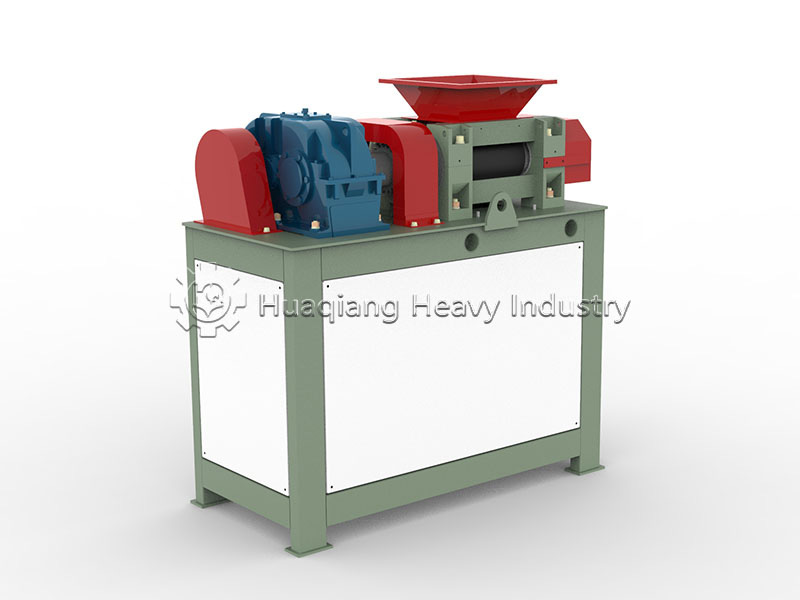
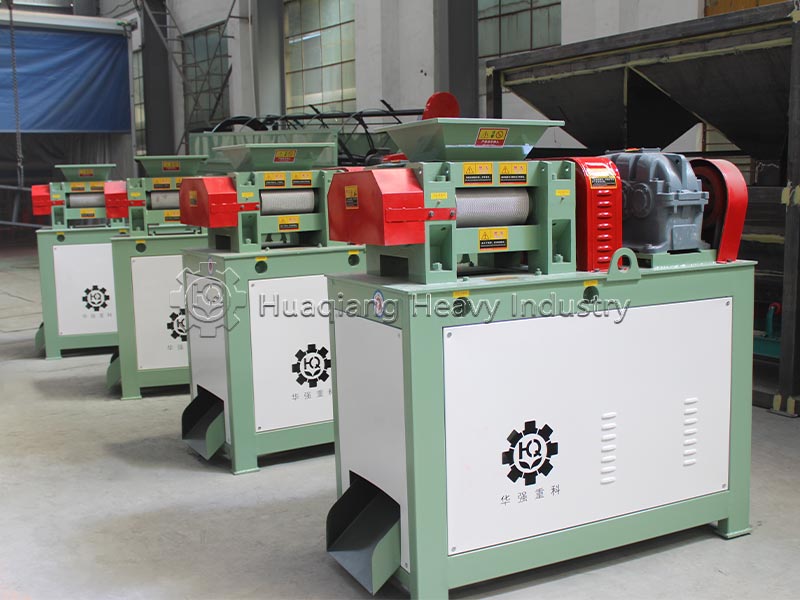
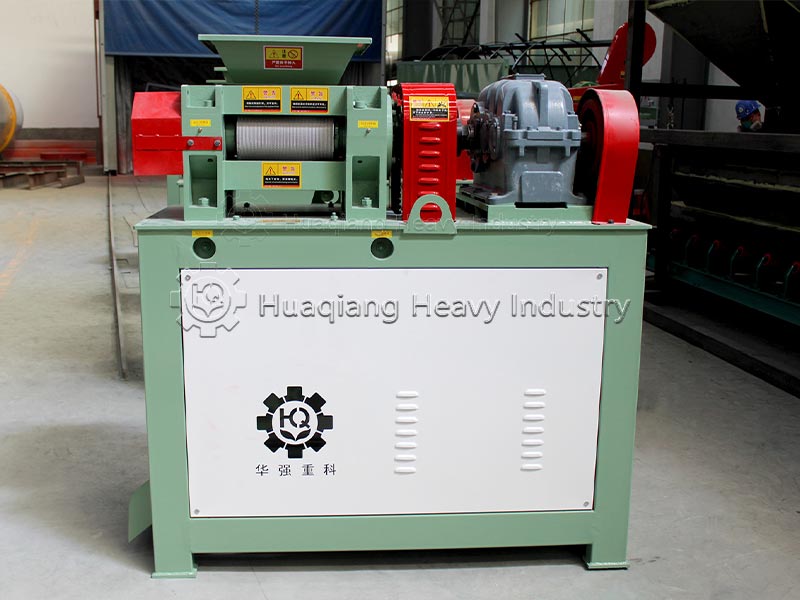
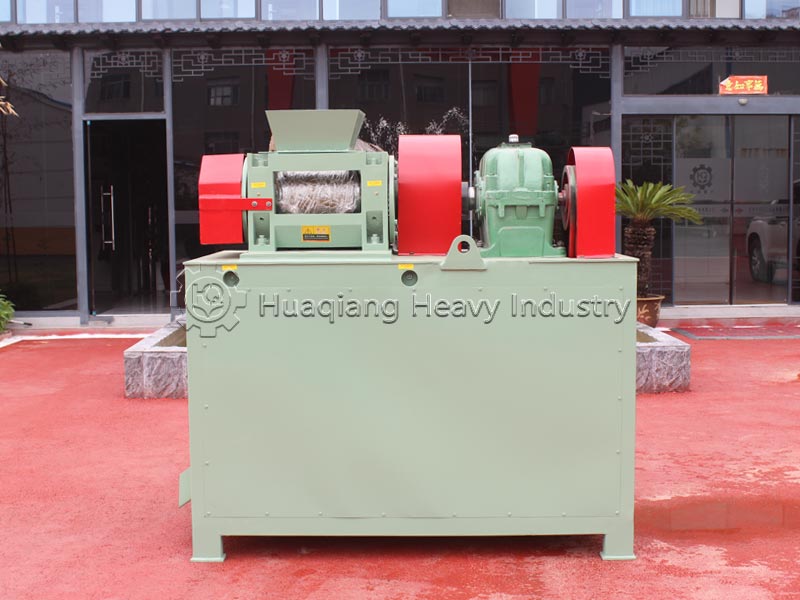
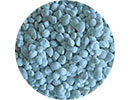
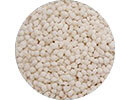
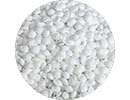
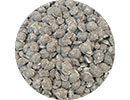
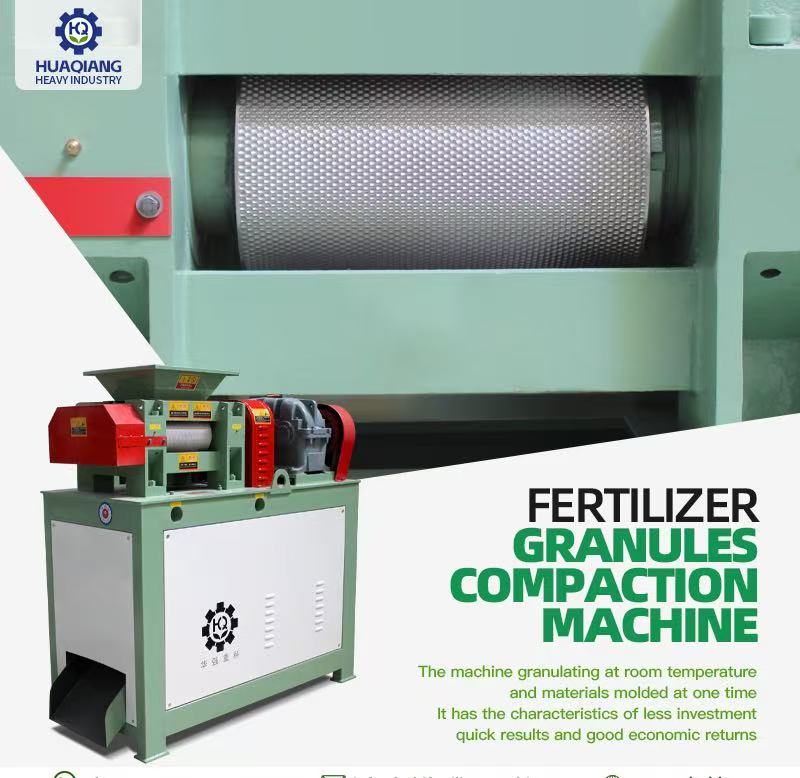
The motor drives the active roller to rotate through the reducer, and the synchronous gear drives the passive roller to rotate synchronously in the opposite direction; the powdery raw material is evenly fed into the gap between the two rollers by a forced screw, and the hydraulic system provides high pressure extrusion force. The material is pressed tightly together in the groove of the roller surface to form a pillow-shaped billet; after the billet leaves the roller surface, it falls into the crushing chamber below. The high-speed toothed roller breaks up the sticky billet, and after being screened by the bottom screen, qualified particles are discharged from the finished product outlet, and fine powder is returned to the feed hopper through the return port for recycling granulation. The whole process is continuous and automated.
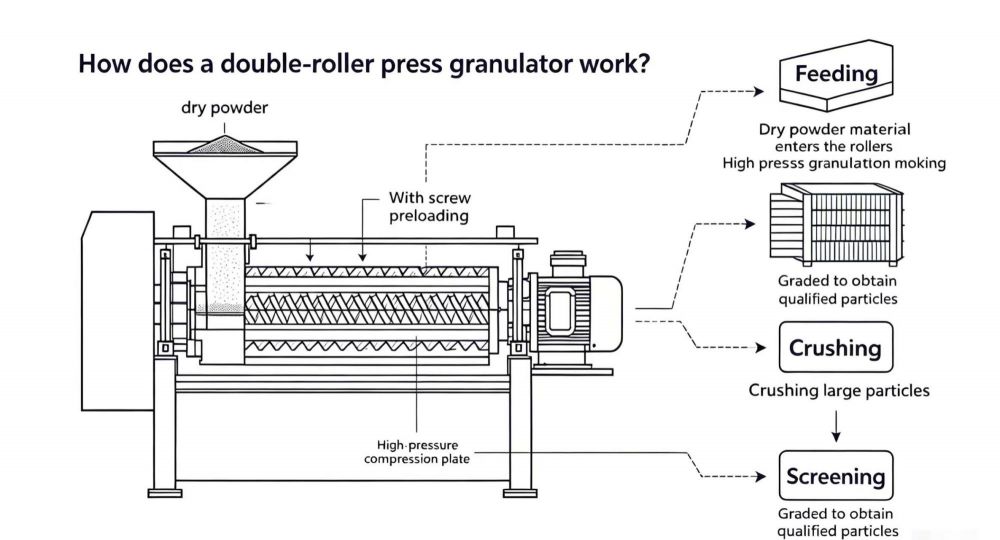
A double roller press granulator mainly consists of the following systems:
Feeding System: This includes a hopper, a screw feeder, and an adjusting device. The hopper stores powdery materials and can be equipped with a stirring device to prevent material bridging. The screw feeder ensures uniform material delivery. The adjusting device controls the feed rate.
Extrusion System:The core component of the equipment, consisting of two parallel, relatively rotating high-strength alloy steel rollers. The roller surfaces have specially shaped grooves to enhance the gripping ability on the material. The roller gap and pressure are adjustable, directly determining the granule forming effect.
Transmission System:This system drives the extrusion rollers, providing the high-pressure power required for extrusion and providing overload protection.
Crushing and Screening System:This system crushes, granulates, and screens the extruded pellets to obtain finished granules that meet specifications.
Frame:The mounting base for all working parts, ensuring the structural stability of the entire machine.
Compared to traditional wet granulation methods (such as rotary drum granulation and disc granulation), double roller extrusion granulation offers the following core advantages:
No Drying Required:Eliminates investment in drying equipment and fuel consumption, resulting in lower overall operating costs.
No Binders Required:Purely physical molding, introducing no additional components and ensuring product purity.
Ambient Temperature Production: Suitable for heat-sensitive materials, avoiding high-temperature decomposition.
High Granule Strength:High-pressure molding produces dense, strong granules that are less prone to breakage.
Clean Production:No wastewater discharge, meeting environmental protection requirements.
There are usually three causes: imbalanced material moisture (too high or too low moisture content will affect forming), excessive gap between the rollers leading to insufficient extrusion force, and wear on the roller surface causing a decrease in surface roughness.
The solution involves three steps: First, control the material moisture content within a reasonable range; then check and reduce the gap between the rollers. If both of these are normal, check the roller surface—if the pattern is worn smooth, repair it by welding or replace the roller skin directly.
Common causes include: sand, gravel, metal, or other hard objects mixed in the material scratching the roller surface; excessively high or low material moisture content leading to increased extrusion resistance; lack of regular lubrication and maintenance; and insufficient wear resistance of the roller skin material itself.
Treatment is divided into three levels: light, moderate, and severe: light scratches can be sanded with fine sandpaper; moderate unevenness requires disassembly and welding repair; severe cracks or deformation require direct replacement. Prevention is more cost-effective than repair—screen out hard objects before feeding, strictly control moisture content, and check lubrication weekly. Also, ensure uniform feeding; uneven feeding will cause annular grooves on the roller surface and uneven particle size.
Blockages often occur at the feed inlet, roller gaps, and discharge outlet, and are sudden malfunctions. Always stop the machine and disconnect power before attempting to fix them. For feed inlet blockages, clean the inner wall of any adhering material; for roller gap blockages, clean residual material and adjust the gap; for discharge outlet blockages, clean debris and adjust the baffle angle. The core of daily prevention is "water control, uniform feeding speed, and daily cleaning"—control moisture content, feed at a uniform speed, and clean residue at the end of each day's work.
| Model | DZJ-I 1.0 | DZJ-I 2.0 | DZJ-I 3.0 | DZJ-I 3.0 |
| Capacity (t/h) | 1-1.5 | 1.5-2.5 | 2-3 | 3-4 |
| Power (Kw) | 11 | 18.5 | 22 | 45 |
| Roller Dimension(mm) | ø150x220 | ø150x300 | ø186x300 | ø300x300 |
| Feed Material Size(mm) | <=0.5 | <=0.5 | <=0.5 | <=0.5 |
| Output Granules Size(mm) | ø2.5-ø10 | ø2.5-ø10 | ø2.5-ø10 | ø2.5-ø10 |
| Gearbox Model | ZLY-160 | ZLY-160 | ZLY-180 | ZLY-224 |
| Rotation Speed (r/min) | 60 | 60 | 60 | 60 |
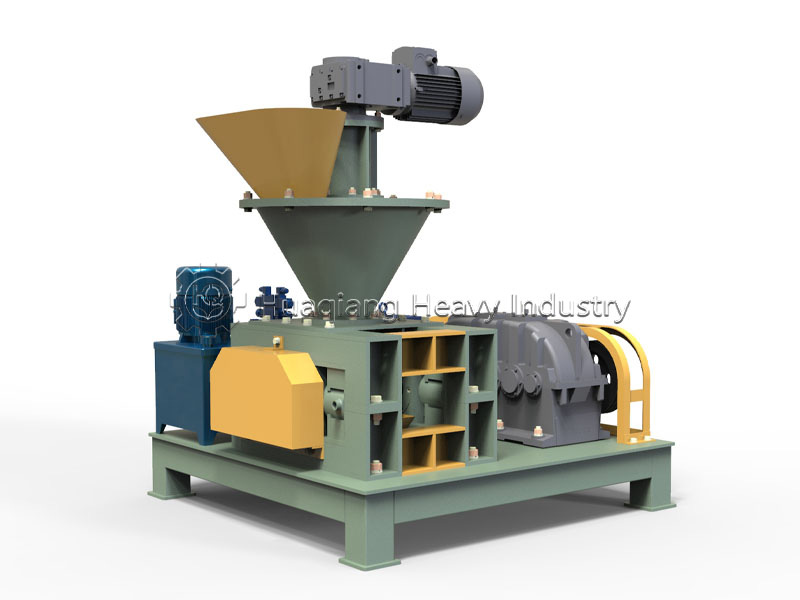
Our company provides clients with complex fertilizer complete sets of equipment technical service, after many years of research and development experience of the compound fertilizer granulator equipment manufacturing , and the meticulous manufacture of hi

This machine is one of the main (biological) organic fertilizer production equipment produced by our company. It is the fertilizer machinery which has been studied, improved and carefully manufactured on the basis of advanced granulating machine at home and abroad.

This series of granulator is a new patented product developed by our company and the Agricultural Machinery Research Institute. It is designed and manufactured by the new technology of wet continuous push rod granulation.