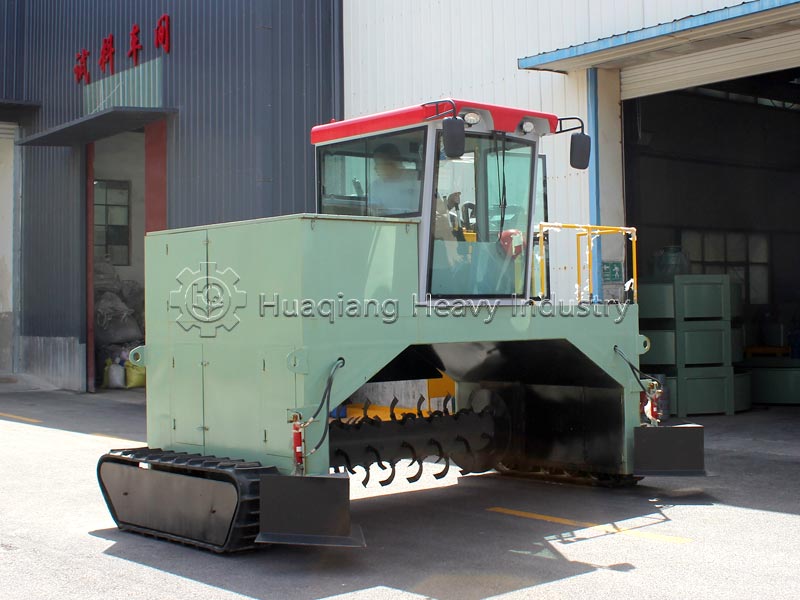

The windrow compost turning machine is specialized fermentation equipment used in complete organic fertilizer production lines and serves as core machinery for the aerobic dynamic composting process. It is primarily used for turning windrow-style compost piles made from organic waste—such as livestock manure, crop straw, sludge, distillers' grains, and furfural residue. By performing operations such as mixing, crushing, oxygenating, and restacking the material, the machine creates an optimal environment for aerobic microbial fermentation.
Unlike traditional trough-type turners, the crawler-type turner does not require the construction of fermentation troughs; instead, it operates directly on materials piled into long windrows on the ground. This design distinction offers significant advantages regarding site adaptability, investment costs, and operational flexibility.

The working principle of the windrow compost turning machine is straightforward. As the machine travels, it straddles the pre-piled, elongated windrow of composting material; a rotating blade shaft (turning drum) suspended beneath the chassis then turns, aerates, and shifts the material.
Specifically, the material is lifted and thrown backward by the high-speed rotating drum, achieving three core functions in the process: turning and mixing (thoroughly blending surface and bottom layers), crushing (breaking up clumps formed during fermentation), and oxygenation (exposing the material to air through the turning action to supply oxygen to aerobic microorganisms).
Windrow compost turners have a wide range of applications across various industries:
Organic fertilizer production: This is the primary application area. The equipment is used for windrow turning and aeration of raw materials such as livestock manure, crop straw, and mushroom substrate residues; it is suitable for both large-scale organic fertilizer plants and small-to-medium-sized production facilities. (See also: Organic fertilizer fermentation production lines.)
Large-scale livestock farms: The machine can operate directly around animal housing to process manure and waste, eliminating the need for transport and enabling on-site composting, thereby addressing environmental compliance challenges.
Environmental protection industry: It is used for composting organic waste such as municipal sludge and food waste, facilitating waste reduction and resource recovery.
Other fields: The equipment is also suitable for horticulture, biomass fermentation, and soil remediation, offering multi-purpose functionality.
Regarding operational environments, crawler-type compost turners can operate in open outdoor areas as well as inside workshops or greenhouses. For more examples of use cases, please refer to the collection of livestock farm application cases.
The most significant advantage of crawler-type compost turners is their exceptional terrain adaptability. By utilizing wide rubber or steel tracks, the equipment exerts a ground pressure only one-third to one-quarter that of wheeled models. This allows for stable operation——without sinking or slipping——on muddy farm sites after rain, soft ground saturated with manure leachate, uneven gravel surfaces, and even gentle slopes.
Crawler-type turners utilize an open-air windrow composting process, eliminating the need to construct concrete fermentation pits or troughs.
The equipment features a fully hydraulic operating system and a lever-style steering control, allowing a single operator to manage the machine. This results in significant labor cost savings, particularly for high-volume daily processing operations.
During the turning process, the rotating blade shaft simultaneously mixes, aerates, and shifts the material while effectively breaking up clumps that form during fermentation.
When selecting a windrow compost turner, it is recommended to evaluate the following aspects:
Suitability for operating conditions: Choose the appropriate track material based on the mud conditions and ground flatness of the actual work site. Rubber tracks are suitable for small-to-medium-scale operations and standard environments, while steel tracks are better suited for large-scale, heavy-duty tasks.
Drive system: A fully hydraulic system is superior to a chain drive, offering a lower failure rate and a longer service life.
Turning performance: Ensure that the turning width and height match the dimensions of your material piles; the uniformity of the turning process directly impacts the fermentation cycle and product quality.
After-sales service: Since the equipment represents a long-term investment, the manufacturer's response speed and spare parts availability are key factors to consider.
| Model | HQ-FD 2500 | HQ-FD 2600 | HQ-FD 3000 |
| Width(mm) | 2500 | 2600 | 3000 |
| Height(m) | 500-1000 | 500-1100 | 500-1200 |
| Stack spacing (m) | 1.0-1.2 | 1.0-1.2 | 1.0-1.2 |
| Max Particle Size (mm) | 250 | 250 | 250 |
| Power | R4102 Turbocharged 90HP Diesel Engine |
R4105 Turbocharged 105HP Diesel Engine |
R6105 Turbocharged 136HP Diesel Engine |
| Rated power speed(r/min) | 2200 | 2200 | 2200 |
| Working speed(m/min) | 6-18 | 6-18 | 6-18 |
| Driving speed(m/min) | 50 | 50 | 50 |
| Processing capacity(m3/h) | 400-600 | 600-800 | 1000-1200 |
| Overall size(m) | 3.64×2.6×2.7 | 3.75×2.6×2.7 | 4.36×2.75×2.95 |

The chain-type turning machine is a core equipment widely used in the fields of organic fertilizer fermentation, solid waste treatment, etc. Its core function is to achieve uniform turning of materials, ventilation and oxygen supply, and accelerated composting through chain conveying and turning operations.

The large wheel compost turner is a type of large-scale organic fertilizer turning machine designed for wide-span, deep fermentation tanks.

The double-screws turning machine is used for fermenting and dump of organic wastes such as livestock manure, sludge garbage, sugar factory filter mud, dregs cake and straw sawdust.