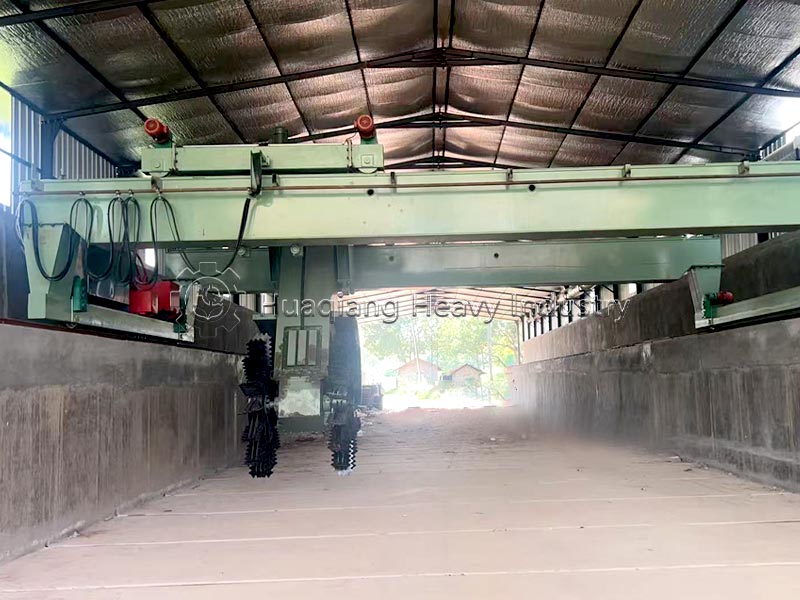
The large wheel compost turner is specialized equipment designed for large-scale, channel-based aerobic fermentation. Its most distinctive feature is a main unit shaped like an oversized rotating wheel, featuring broad, radially arranged paddles or rake teeth. Compared to traditional channel turners, it offers significant space savings while providing a wider turning range, greater working depth, and superior mixing uniformity.
This equipment is primarily used for turning and aerating organic waste—such as livestock manure, sludge, sugar mill filter mud, spent grain/pomace, straw, and sawdust—in large-span, deep-channel systems. It is widely employed in facilities producing organic and compound fertilizers, as well as in sludge treatment plants, horticultural nurseries, and button mushroom farms.
_800x450.jpg)
The working principle of the large wheel compost turner can be summarized as “gravity-assisted throwing” and “radial pulverization.”The equipment spans the track beams above the fermentation trough; once the wheel descends to the base of the material pile, it begins to rotate at high speed.
The specific operational process is as follows: alloy cutting teeth on the wheel rim slice into the pile like milling cutters, scooping up the cold, anaerobic material from the bottom and lifting it to a high point, after which the material falls in a parabolic arc under the influence of gravity. This process achieves three core functions:
1. Oxygenation: Forces contact between the material and the air, supplying ample oxygen for aerobic microorganisms.
2. Cooling: The turning process dissipates internal heat from the pile, preventing excessive temperatures.
3. Pulverization: Impacts and collisions break up compacted clumps, restoring the pile's porosity.
Because the wheel can rotate 360 degrees, it smoothly transfers material from one side of the trough to the other—achieving a "lateral shift" effect during turning—and ensures there are no "dead zones" within the fermentation trough.
Large wheel compost turners have a wide range of applications:
Livestock and poultry waste treatment: Fermentation and turning of viscous manure (such as chicken, pig, cattle, and sheep manure). The rotary-disc structure is highly effective at breaking down and processing materials prone to compaction, such as high-moisture cattle manure.
Organic waste resource recovery: Composting of fibrous materials such as crop stalks, sawdust, spent mushroom substrate, and herbal medicine residues.
Municipal sludge treatment: Fermentation, decomposition, and dewatering of sludge and waste.
Industrial by-product treatment: Fermentation of organic by-products such as sugar mill filter mud and various types of pomace or oilseed cake.
Horticulture and cultivation: Fermentation and decomposition of substrates for horticultural facilities and button mushroom farms.
The machine can turn material at depths ranging from 1.5 to 3 meters. This depth far exceeds that of standard turning equipment, allowing for the processing of thicker material layers and increasing fermentation output per unit area.
The turning width can reach up to 30 meters. Wide fermentation channels facilitate easier loading, unloading, and transport by forklifts and loaders, thereby improving operational efficiency. The machine offers significant advantages when handling extra-wide fermentation channels exceeding 10 meters.
It utilizes an energy-efficient drive mechanism, reducing energy consumption by approximately 70% compared to traditional turning equipment for the same workload. Depending on the model, total power consumption is around 30 kW, keeping production costs manageable.
Symmetrical wheel-based turning, combined with the lateral movement of a variable-speed shifting carriage, ensures thorough turning across the entire fermentation channel with no missed areas.
Equipped with a fully automated electrical control system, the machine operates without the need for manual intervention. An intelligent variable-frequency control system allows for the flexible adjustment of travel speed and turning frequency, supporting fully automated, unattended operation.
| Model | Main Motor | Small Car Moving Motor | Big Car Moving Motor | Hydraulic Pump Motor |
| LP-10m | 55KW | 1.5KWX4 | 1.5KWX2(4) | 4KW |
| LP-12m | ||||
| LP-15m | ||||
| LP-20m |

The chain-type turning machine is a core equipment widely used in the fields of organic fertilizer fermentation, solid waste treatment, etc. Its core function is to achieve uniform turning of materials, ventilation and oxygen supply, and accelerated composting through chain conveying and turning operations.

The double-screws turning machine is used for fermenting and dump of organic wastes such as livestock manure, sludge garbage, sugar factory filter mud, dregs cake and straw sawdust.
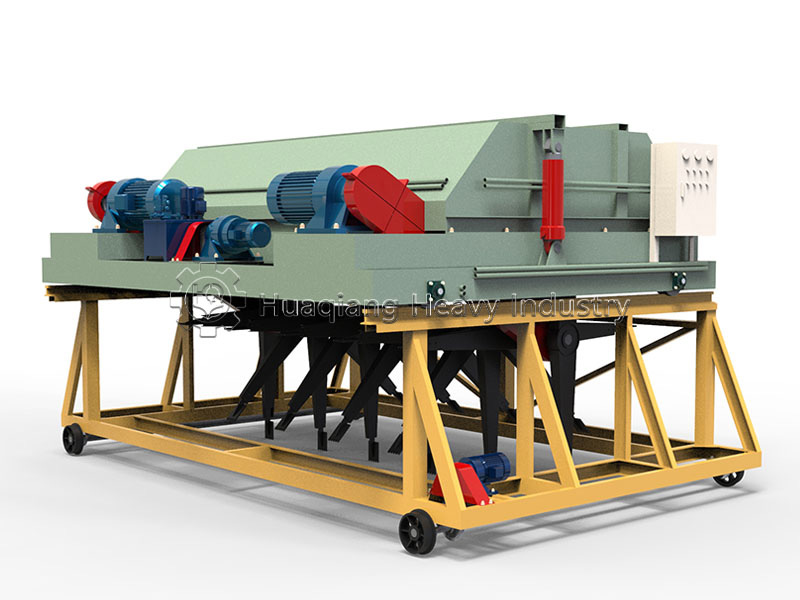
Hydraulic compost turners are used for the fermentation and turning of organic wastes—such as livestock and poultry manure, sludge, sugar mill filter mud, dregs and press cakes, straw, and sawdust—and are widely employed in organic fertilizer plants.