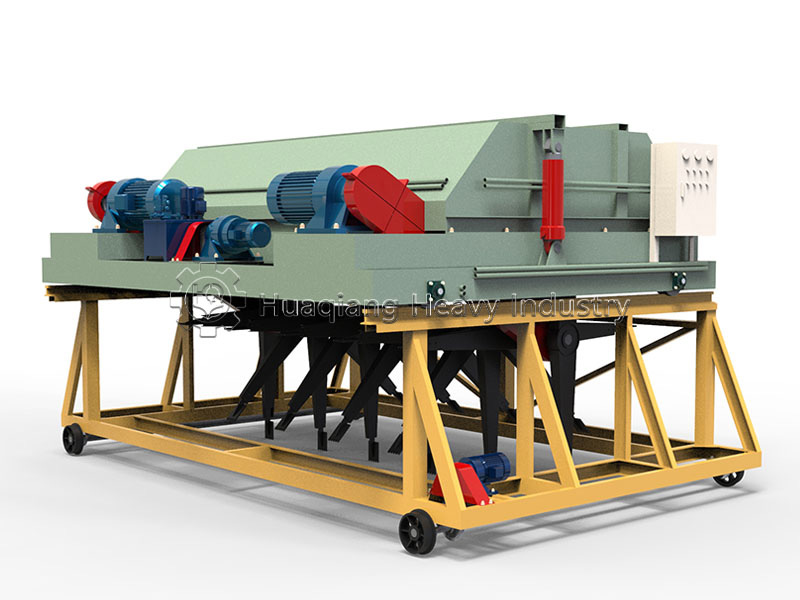


The hydraulic compost turning machine is a specialized piece of equipment designed for the aerobic fermentation of organic waste and serves as core machinery in channel-based fermentation processes. By operating continuously within a fixed fermentation channel, it turns, mixes, and aerates the material, thereby accelerating the decomposition and maturation of organic matter.
Compared to standard electric-motor-driven models, the hydraulic compost turning machine replaces traditional rigid drive systems——such as chains or gears——with a fully hydraulic drive system. The fundamental distinction lies not in the turning principle itself, but in the flexibility of the power output and the control logic governing lifting operations. This upgrade enables superior performance when handling complex materials or operating in deep fermentation channels.
The core working principle of the hydraulic compost turning machine lies in the synergistic operation of “hydraulic drive”and “turning/throwing”The equipment consists of four main components: the travel system, the turning rotor, the hydraulic lifting mechanism, and the electrical control system.
During operation, the machine moves forward at a constant speed along fixed rails installed on the sidewalls of the fermentation channel. A high-power hydraulic motor drives the turning rotor to rotate at high speed; alloy mixing teeth, arranged in a spiral pattern on the rotor, cut deep into the material. As they rotate, the teeth break up and toss the compacted material, ensuring full contact with the air. Simultaneously, the hydraulic lifting mechanism adjusts the rotor's position in real-time based on the height of the compost pile, ensuring a consistent turning depth.
Drive Unit: An electric motor transmits power to a cycloidal pin-wheel reducer, which then transfers it to the turning drum via a sprocket.
Turning Unit: Mixing paddles or turning blades on the drum are arranged in a spiral or row pattern; they turn and mix the material while shifting it backward by 0.2–1 meter.
Travel Unit: Drives the equipment along the rails, enabling coverage of the entire channel.
Lifting Unit: Utilizes a hydraulic lifting system comprising a hydraulic pump station, solenoid valves, hydraulic hoses, and hydraulic cylinders.
Transfer Carriage: Used to move the equipment between different fermentation channels.
Livestock and poultry manure (chicken, pig, cattle, sheep, etc.)
Municipal sludge and waste
Sugar mill filter mud
Distillers' grains and oilseed cakes
Straw and sawdust
Pay attention to the following points for daily maintenance:
Pre-start checks: Hydraulic oil level, potential pipeline leaks, debris on the rails, limit switches, and wear on the rake teeth.
Lubrication: After installation and power-up, inject 3 kg of grease into the bearing housings; replenish after 72 hours of operation.
Hydraulic system: Regularly change the hydraulic oil and inspect pipelines for leaks.
Replacement of wear parts: Promptly replace worn turning teeth; replacing a single tooth takes only 5-10 minutes.
Centered on hydraulic drive technology, the hydraulic compost turning machine combines powerful performance, thorough turning, energy efficiency, durability, and intelligent, user-friendly operation. It overcomes the persistent issues of shallow turning and frequent machine jamming associated with traditional equipment, significantly shortening the fermentation cycle while ensuring uniform material decomposition.
The adoption of hydraulic compost turners marks a leap forward in organic fertilizer fermentation processes, shifting operations from crude manual methods to intelligent, factory-scale control. For enterprises aiming to produce high-quality organic fertilizer, investing in a reliable hydraulic compost turner not only ensures regulatory compliance but also serves as an effective strategy for reducing costs and enhancing efficiency.
| Model | Main Motor | Walking Motor | Moving Motor | Hydraulic Pump Motor |
| FPY4 | 22kw | 1.5kw | 1.1kw | 4kw |
| FPY5 | 30kw | 1.5kw | 1.5kw | 4kw |
| FPY6 | 37kw | 2.2kw | 1.5kw | 4kw |

The chain-type turning machine is a core equipment widely used in the fields of organic fertilizer fermentation, solid waste treatment, etc. Its core function is to achieve uniform turning of materials, ventilation and oxygen supply, and accelerated composting through chain conveying and turning operations.

The large wheel compost turner is a key equipment in the fields of agricultural environmental protection and organic fertilizer production. Its core function is to efficiently turn, stir and aerate the piled organic waste (such as livestock and poultry manure, straw, mushroom residue, sludge, etc.), accelerate the composting process of the materials, and at the same time achieve deodorization, sterilization and moisture content adjustment, and finally convert it into high-quality organic fertilizer.

The double-screws turning machine is used for fermenting and dump of organic wastes such as livestock manure, sludge garbage, sugar factory filter mud, dregs cake and straw sawdust.