The double screws compost turning machine is a piece of turning equipment specifically designed for aerobic fermentation troughs; it is suitable for turning and aerating organic wastes such as livestock and poultry manure, sludge, sugar mill filter mud, straw, and sawdust during the fermentation process. The equipment straddles the rails on both sides of the fermentation trough and travels longitudinally along it, utilizing two parallel spiral shafts that rotate synchronously in opposite directions to deeply turn, break up, and mix the materials within the trough.
The core components of the equipment are two symmetrically arranged spiral shafts featuring wear-resistant alloy spiral blades welded in a staggered pattern. During operation, the left spiral throws material to the right while the right spiral throws it to the left; the blade angle continuously excavates and lifts material from the bottom of the channel, scattering it in a crisscross pattern through the air.
The value of this design lies in its ability to go beyond merely turning the surface layer; it effectively swaps the positions of the bottom-layer anaerobic material and the top-layer material, achieving true three-dimensional turnover across the entire width and depth of the channel. This ensures thorough contact between the material and the air, providing ample oxygen for aerobic microorganisms.
The double screws compost turning machine covers three main areas:
Used in conjunction with fermentation troughs and screening equipment to enable large-scale, standardized production. The turner serves as the primary site for the biochemical reaction process.
Facilitates the centralized fermentation of manure into organic fertilizer, enabling resource recovery and utilization.
Processes organic solid waste such as municipal sludge and kitchen waste. When used with enclosed fermentation sheds and negative-pressure odor extraction systems, it ensures high capture rates for dust and odors generated during turning, making it easier to pass environmental impact assessments.
Also suitable for turning and aerating compost substrates at horticultural nurseries and button mushroom cultivation facilities.
The twin spirals operate in a counter-rotating, synergistic manner, casting material across a distance of 1.5-2.2 meters and achieving fermentation uniformity of over 92%. Issues common to traditional single-spiral turners—such as dead zones at the edges and corners or a "dead layer" of unmixed material at the bottom——are virtually eliminated by the twin-spiral design.
It handles a wide range of organic wastes——including livestock manure, crop stalks, sludge, and sugar mill filter mud—and accommodates moisture content levels between 30% and 80% without complex pre-treatment. It can fully turn material in a single pass within deep troughs (1.5-2.0 meters deep and 3-6 meters wide), making it ideal for processing mixtures such as livestock manure with stalks or municipal sludge blended with bulking agents. The spiral blades feature a self-cutting action against fiber entanglement and minor clumping, resulting in fewer jams compared to standard straight-tooth cutter shafts.
The machine body is constructed from thickened carbon steel treated for rust, corrosion, and wear resistance. The spiral blades are made of high-manganese steel or high-chromium cast iron, with options for a tungsten carbide wear-resistant coating. Equipped with limit switches, the system maintains a failure rate of less than 0.5%.
Q: What is the actual difference between twin-screw and single-screw models?
A: The main issue with single-screw turners is uneven turning, which tends to create a "dead layer" of unmixed material at the bottom of the trough. Twin-screw models utilize two counter-rotating shafts working in tandem to gather material from the sides toward the center and lift it from the bottom, achieving full-profile turnover. Simply put, a single-screw turner “ sweeps the surface” whereas a twin-screw turner“turns the material all the way to the bottom”.
Q: Is the equipment installation complex?
A: The equipment features a compact design and is easy to install. The key is ensuring shaft parallelism and proper gear backlash during installation. Manufacturers typically provide on-site installation guidance.
Q: Can it handle high-moisture materials?
A: Yes. The equipment is suitable for materials with a moisture content of 30%-80%. For high-moisture or clumped materials, the hydraulic drive system delivers stable power, allowing for easy breakdown without the need for pre-processing.
Q: Can a single machine only service one trough?
A: No. The equipment can be paired with a transfer carriage to enable automatic movement between multiple troughs. A single machine can service several fermentation troughs in rotation, significantly reducing equipment investment costs.
| Model | Main Motor | Small Car Moving Motor | Big Car Moving Motor |
Hydraulic Pump Motor |
| SLP-10m | 15KW | 1.5KWX2 | 1.5KWX2(4) | 4KW |
| SLP-12m | ||||
| SLP-15m | ||||
| SLP-20m |

The chain-type turning machine is a core equipment widely used in the fields of organic fertilizer fermentation, solid waste treatment, etc. Its core function is to achieve uniform turning of materials, ventilation and oxygen supply, and accelerated composting through chain conveying and turning operations.

The large wheel compost turner is a type of large-scale organic fertilizer turning machine designed for wide-span, deep fermentation tanks.
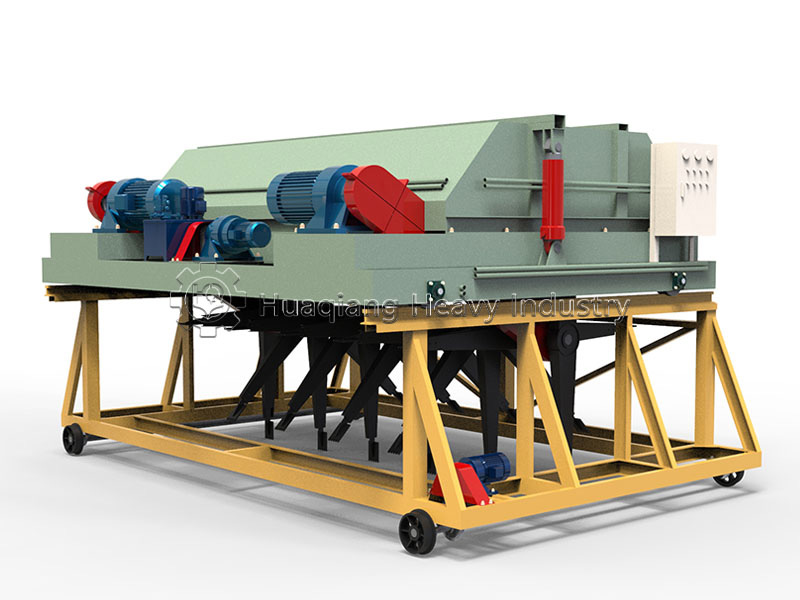
Hydraulic compost turners are used for the fermentation and turning of organic wastes—such as livestock and poultry manure, sludge, sugar mill filter mud, dregs and press cakes, straw, and sawdust—and are widely employed in organic fertilizer plants.