In the fields of organic fertilizer production, livestock manure treatment, and solid waste resource utilization, turning is a critical step that determines the success and efficiency of aerobic fermentation. As the core equipment for channel-type aerobic composting, the chain plate compost turning machine (also known as a chain plate compost turner) is increasingly becoming standard equipment for large-scale livestock farms, organic fertilizer plants, and solid waste treatment projects.
The chain-plate compost turning machine is a heavy-duty turning machine specifically designed for channel-type aerobic composting processes. It is primarily used for turning and aerating organic waste——such as livestock manure, sludge, sugar mill filter mud, dregs and press cakes, and straw or sawdust——during fermentation. Operating along rails installed on the fermentation channels, the machine utilizes a high-strength chain-plate structure to toss, aerate, and agitate the composting material, thereby integrating deep-layer turning, crushing, and mixing into a single operation.
The core of the chain plate compost turning machine comprises a frame, a drive system, a chain-plate turning assembly, a lifting mechanism, and a rail-based travel system. Its working principle can be summarized as a combined process of “heavy-duty chain-plate turning and mixing” and “longitudinal travel/relocation”:
As the equipment moves along fixed rails, wear-resistant paddles mounted on the chain assembly penetrate the material layer; they lift the material accumulated at the bottom, break it up, and push it rearward, thereby inducing a three-dimensional convective movement. This process effectively eliminates anaerobic dead zones within the material, ensures thorough oxygen penetration across all layers of the windrow, significantly boosts aerobic microbial activity, and accelerates both moisture evaporation and the decomposition (maturation) process.
The chain plate compost turning machine is highly favored in large-scale composting operations primarily due to the following five core advantages:
The chain plates reach deep into the bottom layer of the material, ensuring thorough turning with no dead zones; this resolves common issues such as poor decomposition and slow fermentation at the bottom. Turning uniformity exceeds 98%.
The chain-plate shovel teeth feature an integrated crushing function, capable of breaking up large straw stalks and manure clumps directly, thereby eliminating the need for tedious pre-crushing steps. During the turning process, the material remains on the support plates for an extended period and is dispersed from a height, maximizing air contact and facilitating moisture reduction.
The equipment travels along rails for continuous turning, supporting 24-hour non-stop operation; its processing capacity is dozens of times that of manual turning.
The core chain plates and shovel blades are made from high-strength, wear-resistant materials that withstand corrosion and abrasion, making them suitable for harsh composting environments. Wear parts can be replaced individually, ensuring convenient daily maintenance.
Chain plate compost turning machines are widely used in the following areas:
Organic fertilizer plants: Serving as core fermentation equipment, they integrate with automatic feeders, screening machines, and granulators to form large-scale organic fertilizer production lines;
Large-scale livestock farms: Processing animal manure such as chicken, cattle, and pig waste;
Municipal sludge treatment plants: Capable of precisely mixing sludge with conditioning agents during turning, and suitable for handling high-viscosity materials;
Sugar mills and pharmaceutical residue processing: Featuring adjustable chain-plate angles and a design that minimizes material fragmentation during turning;
Co-processing of food waste: Utilizing a special anti-tangling chain-plate design to handle materials with long fibers;
Fermentation and composting sites, such as Agaricus bisporus (button mushroom) farms.

The large wheel compost turner is a type of large-scale organic fertilizer turning machine designed for wide-span, deep fermentation tanks.

The double-screws turning machine is used for fermenting and dump of organic wastes such as livestock manure, sludge garbage, sugar factory filter mud, dregs cake and straw sawdust.
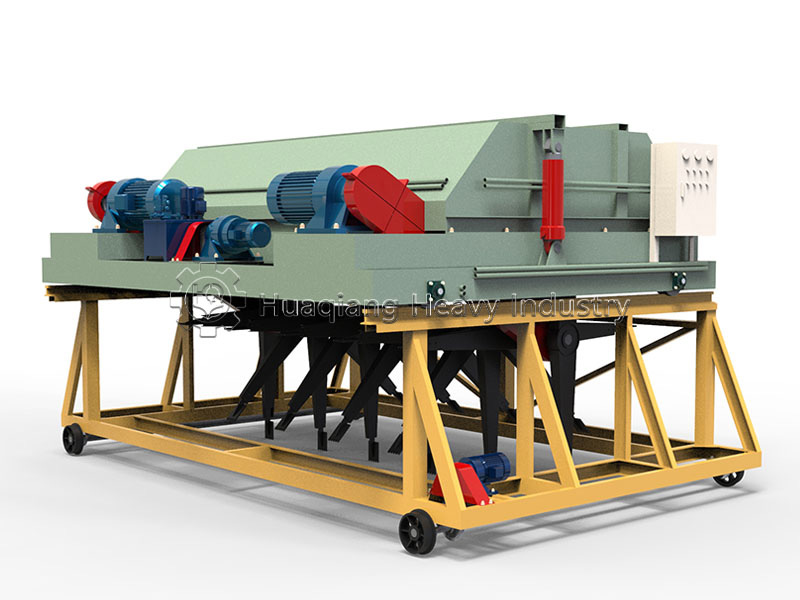
Hydraulic compost turners are used for the fermentation and turning of organic wastes—such as livestock and poultry manure, sludge, sugar mill filter mud, dregs and press cakes, straw, and sawdust—and are widely employed in organic fertilizer plants.